laravel-ai-finops
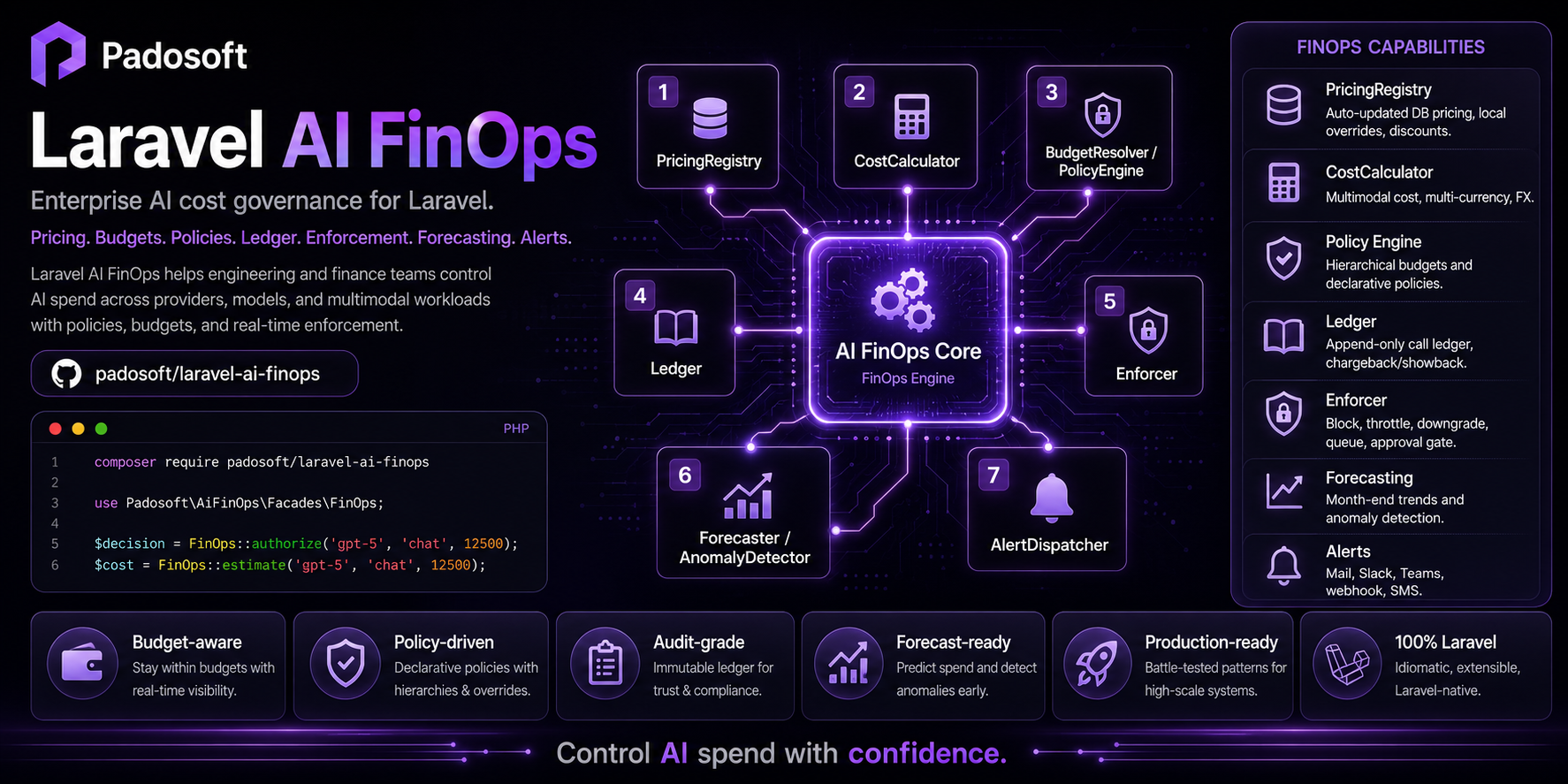




laravel-ai-finops turns the official
laravel/aiSDK into a governed, audited cost control plane.
One hook meters every AI call — any provider, any model — then sets budgets, enforces policies in
flight, attributes spend per tenant and per agent step, forecasts overruns and routes by
quality-per-euro. Self-hosted, multi-tenant, EU-compliant by design.
In five minutes you’ll know exactly what this package is, the problem it solves, why it beats every
“just track the tokens” alternative, and where to click next. Every other page goes deeper — this one
gives you the whole picture.
What it is — in one minute
If you ship AI features on Laravel, your spend is invisible until the invoice arrives. The official
laravel/ai SDK normalizes every response to tokens only and throws away the provider’s real billed
cost. There is no budget, no per-tenant attribution, no kill switch, no forecast — just a number you
discover at the end of the month.
laravel-ai-finops plugs into the laravel/ai lifecycle at a single point and gives the
non-deterministic, fast-growing part of your bill the same controls your business logic has always had:
- Meter every call — normalize provider, model, tokens, tenant, cost-center, agent step, purpose and
trace-idinto one immutableAiCallEnvelope, written to an append-only ledger. - Govern spend before it happens — hard budgets, kill switches, a declarative policy DSL and human
approvals block runaway cost in flight (HTTP402), not after the fact. - Explain every euro — a truest-cost cascade prices each call by the best number available, and
records which method it used so you can tell an invoiced fact from a tariff estimate.
In one line: the FinOps brick
laravel/aiis missing — meter, budget, enforce, attribute and
forecast AI spend across every provider, from inside your own Laravel app.
The problem it solves
Every team shipping AI hits the same wall: cost is untracked, unattributed and unstoppable. Here is the
gap this package closes.
| Without laravel-ai-finops | With laravel-ai-finops |
|---|---|
laravel/ai keeps tokens and discards the provider’s real billed cost — you can never reconcile the invoice. |
A global capture recovers usage.cost (e.g. OpenRouter) before it’s dropped; the truest number wins. |
| “Cost” is one number you see at month-end, after the money is gone. | A live, append-only ledger prices every call as it happens — by tenant, agent step, model and purpose. |
| A runaway agent loop bills thousands before anyone notices. | Hard budgets + kill switches abort the next call with HTTP 402; a pre-flight estimate blocks the call that would exceed. |
| Pricing is hard-coded and instantly stale across 2,600+ models. | Multi-source pricing — LiteLLM ⊕ OpenRouter live ⊕ your manual overrides — with a per-provider authority map and freshest-sync tie-break. |
| Paying a flat-rate plan (Claude Max, OpenAI Pro)? You still “pay” per token in your reports. | Subscription coverage windows meter covered calls at €0 while active (tokens still tracked). |
| You can’t tell finance what each team, tenant or feature actually costs. | Chargeback/showback by cost-center, multi-currency, with an immutable audit trail. |
| No way to know if you’ll blow the budget next week. | Forecasting, anomaly detection and a what-if simulator that replays traffic re-priced on another model. |
Who it’s for
Already using the official SDK? Metering starts automatically the moment the package is enabled — zero per-provider wiring, zero code changes to your agents.
Attribute and cap spend per tenant, user, cost-center and brand. Per-tenant kill switches and chargeback reports your finance team can actually use.
A trace-id + per-step attribution breaks an entire agent run’s cost down step-by-step under one trace — pairs natively with laravel-flow.
Budgets, policy-as-code, forecasts, ESG footprint and cost-aware routing — the governance layer that turns AI from an unbounded liability into a managed line item.
Why it’s different — the moats
Most tools either track cost or block it. This package does both, self-hosted, and goes further
than anything in the Laravel ecosystem.
A single listener on the laravel/ai lifecycle meters OpenAI, Anthropic, Gemini, Mistral, DeepSeek, xAI, Bedrock, Azure and padosoft/laravel-ai-regolo — no per-provider integration code.
The SDK normalizes responses to tokens and drops the real billed cost. A global HTTP capture reads the provider’s usage.cost before it’s discarded — so each call is priced by the truest number that exists.
Every row is priced (a) actual billed → (b) tokens × tariff → © estimated tokens × tariff and records cost_method + tokens_estimated + billed_cost. You always know invoiced truth from estimate.
LiteLLM’s 2,600+ model DB ⊕ OpenRouter’s live API ⊕ your local EUR/per-1M overrides. A per-provider authority map picks who actually bills you; overrides always win.
N-scope budgets (global → tenant → user → cost-center → provider → model → agent → purpose) × periods, soft/hard. A hard limit blocks the next call — and, with a pre-flight estimate, the one that would exceed.
Declarative block / require_approval / downgrade / throttle / queue rules with an approval workflow and scoped kill switches — governance as code, simulatable before you ship it.
Define a [from, to] window per provider and covered calls are metered at €0 while your plan is active — routing even prefers covered providers to “stay within the plan”.
Pick the cheapest model that clears a quality bar (scores sourced from padosoft/eval-harness) — spend the minimum that still meets your standard.
Run-rate forecasting, spike anomaly detection, a what-if simulator, live streaming meter with mid-stream cutoff, CO₂/ESG footprint, prepaid credit pools, price-change watcher and a natural-language FinOps copilot.
See it: the FinOps cockpit
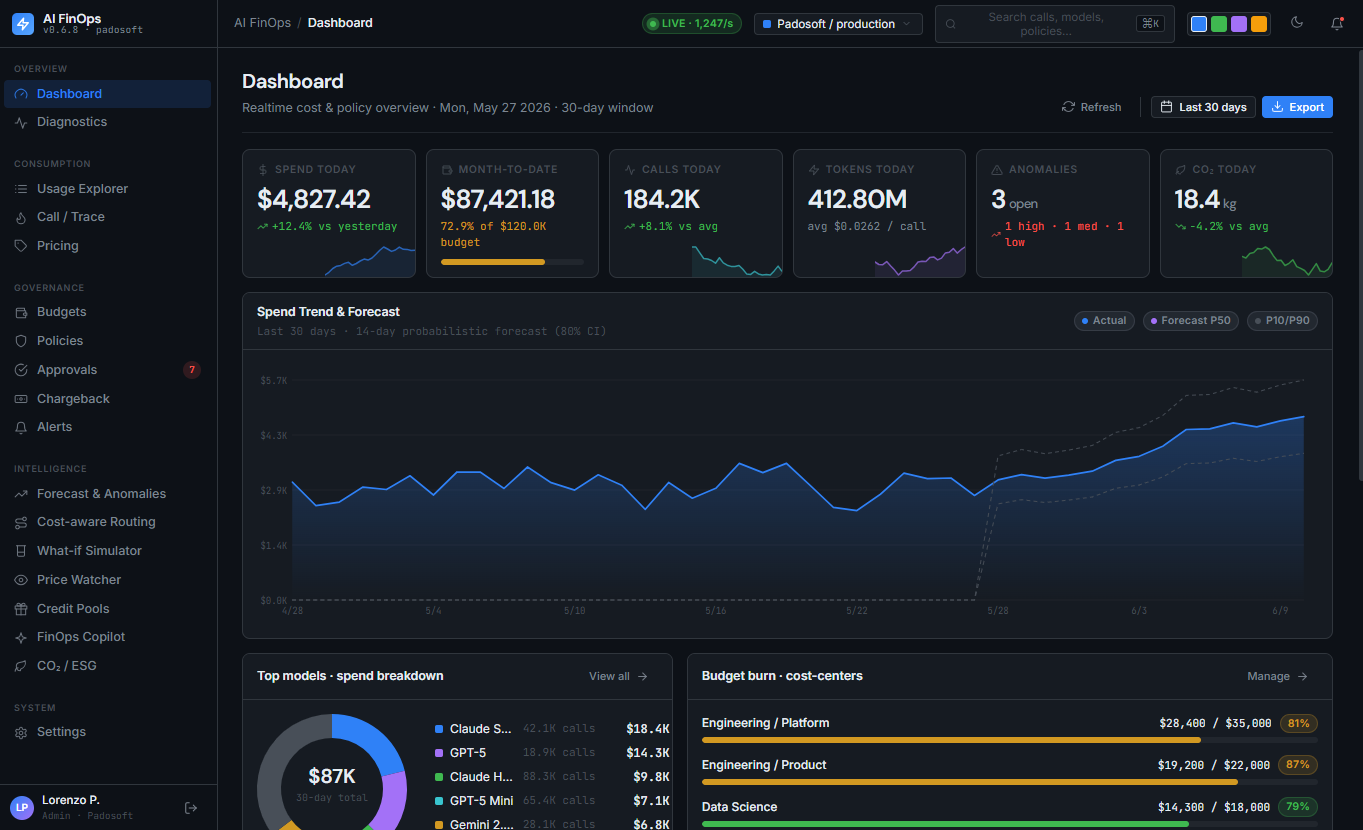
A production-grade web admin panel ships separately as
padosoft/laravel-ai-finops-admin — a
React + Vite + Tailwind console driving every endpoint: live cost dashboards, budgets and burndown,
policies and approvals, cost-aware routing, forecasting and anomalies, what-if, chargeback, alerts,
credit pools, CO₂/ESG and a natural-language copilot. It consumes this package’s API directly — no mocks.
laravel-ai-finops vs. the alternatives
| Capability | laravel-ai-finops | DIY logging | LLM gateways (Helicone / Langfuse) | Cloud cost tools (Vantage / CloudZero) |
|---|---|---|---|---|
Single hook over the official laravel/ai SDK |
✅ | ❌ | ➖ | ❌ |
| Recovers the provider’s real billed cost | ✅ | ❌ | ➖ | ➖ |
| In-flight hard-budget block (HTTP 402) | ✅ | ❌ | ➖ | ❌ |
| Policy DSL + human approvals | ✅ | ❌ | ❌ | ➖ |
| Flat-rate subscription €0 coverage windows | ✅ | ❌ | ❌ | ❌ |
| Cost-aware routing by quality-per-euro | ✅ | ❌ | ➖ | ❌ |
| Per-tenant + per-agent-step chargeback | ✅ | ➖ | ➖ | ➖ |
| Self-hosted in your Laravel DB, you own the data | ✅ | ✅ | ❌ | ❌ |
Legend: ✅ built-in · ➖ partial / extra cost / not exposed · ❌ not available.
How it fits together
Each call becomes an AiCallEnvelope and flows through one hook: pre-flight policy, then post-flight
cost cascade into an immutable ledger that feeds budgets, alerts, forecasts and routing.
The cost cascade picks the truest number available:
Start in 30 seconds
Install the package
composer require padosoft/laravel-ai-finops
php artisan vendor:publish --tag=ai-finops-config
php artisan vendor:publish --tag=ai-finops-migrations
php artisan migrate
If you already use
laravel/ai, metering starts automatically — every prompt, embedding and
stream is priced and written to the ledger.Add a budget and watch enforcement kick in
use Padosoft\LaravelAiFinOps\Models\Budget;

Budget::create([
    'name' => 'Monthly cap', 'scope_type' => 'global',
    'limit_amount' => 500, 'currency' => 'USD', 'period' => 'monthly',
    'soft_limit_pct' => 80, 'hard' => true,
]);
// Once the hard limit is reached, further AI calls abort with HTTP 402.
Attribute an agent run’s cost, step by step
app(\Padosoft\LaravelAiFinOps\Support\TraceContext::class)->within(
    ['trace_id' => $runId, 'agent_step' => 'summarize', 'tenant_id' => $tenantId],
    fn () => $agent->respond($prompt), // every laravel/ai call here is metered under this trace+step
);
→ Full Quickstart · → Installation · → Worked Example
Batteries included for AI-assisted development
This repo ships AI batteries — a CLAUDE.md working guide, an AGENTS.md workflow contract and
invocable .claude/skills/ encoding the TDD loop, the metering/pricing rules and the docs-sync
discipline. Open the package in Claude Code, Cursor, Copilot or Codex and your agent already knows the
house rules.
